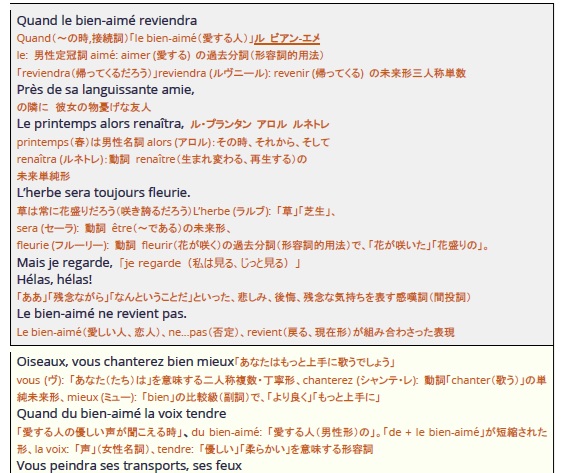
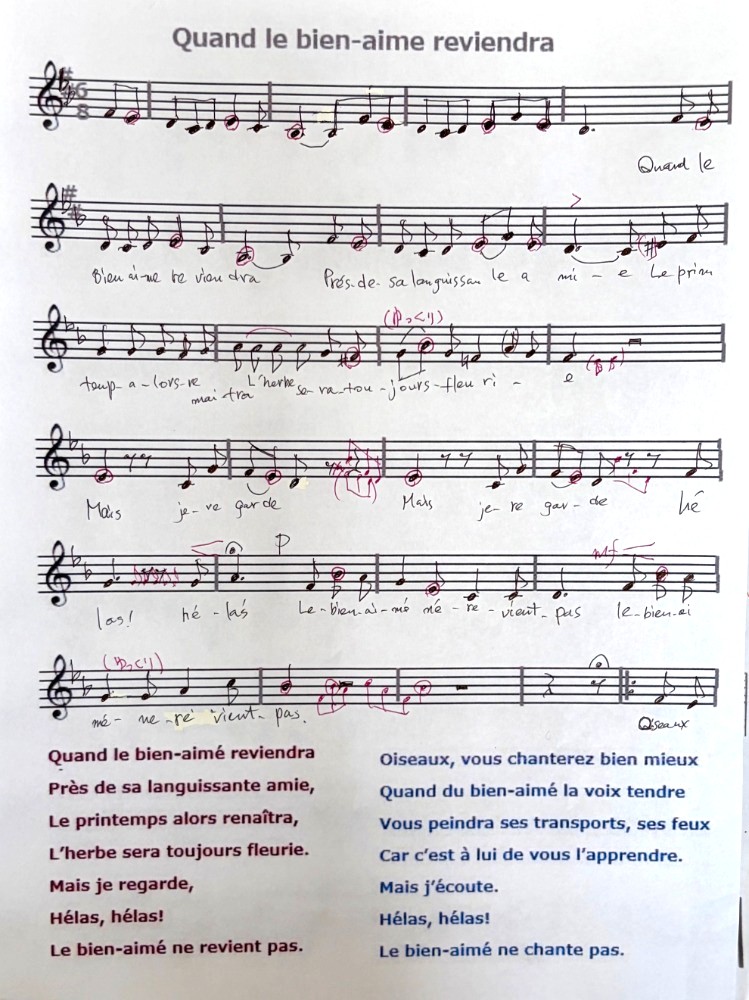
Quand le bien-aimé reviendra Près de sa languissante amie, Le printemps alors renaîtra, L’herbe sera toujours fleurie. Mais je regarde, Hélas, hélas! Le bien-aimé ne revient pas.
When the beloved will return Near his languid <longing> friend, Spring will be reborn, The grass will always be in bloom. But I look, Alas, alas! The beloved does not return.
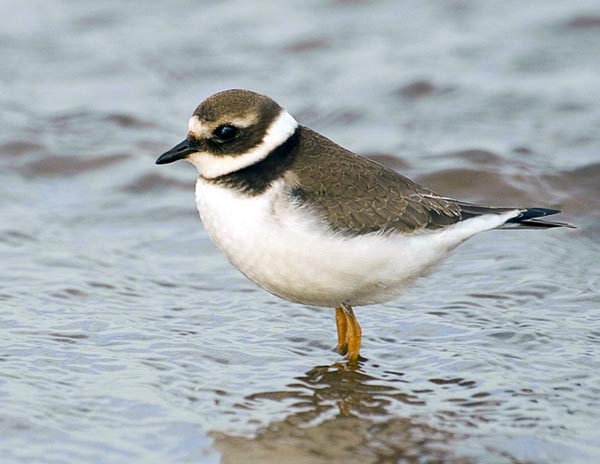
Oiseaux, vous chanterez bien mieux Quand du bien-aimé la voix tendre Vous peindra ses transports, ses feux Car c’est à lui de vous l’apprendre. Mais j’écoute. Hélas, hélas! Le bien-aimé ne chante pas.
Birds, you will sing much better When the beloved’s tender voice You will paint its transport, its lights Because it is up to him to teach you. But I listen. Alas, alas! The beloved does not sing.
Écho que j’ai laissé cent fois De mes regrets, de ma tristesse Il revient, peut-être sa voix Te demande aussi sa maîtresse Paix! il appelle. Hélas, hélas! Le bien-aimé n’appelle pas.
Echo that I left a hundred times From my regrets, from my sadness He comes back, maybe his voice Also ask you his mistress Peace! he calls. Alas, alas! The beloved does not call.
It seams that TaeHyung survived from his physical hardships occurred during his no-audience performance in Seoul. I was worried about the mental damage on him. He looked good at L.A. concerts and enjoyed his short trip to Hawaii. He started his new projects in Seoul after he did something that surprised people, releasing his half-naked private photos. It was his style, he could not survive without doing something strange, amused and surprised Armies. It is my joy seeing/watching a man growing and developing himself through uncertain but exiting challenges.
Merci de partager ces moments merveilleux de Michel Dens que mes parents ont bien connu dés ces débuts: voix exceptionnelle jamais remplacée, homme charmant…et merveilleux souvenirs de vacances à Villeneuve-Loubet pour mes parents….Merci
F major(Medium voice) Tempo-Medium Piano accompaniment(karaoke-score) La
古諾小夜曲 Gounod Serenade(France)for a Victor-Marie Hugo poem (so の伴奏)
<練習中の音声>
練習を始めて1週間(30回以上は歌ったかな?)最初の発音から間違ってる “Ka tyu” ですよ!
Sérénade
Victor Hugo
English Translation
Quand tu chantes, bercée Le soir entre mes bras, Entends-tu ma pensée Qui te répond tout bas? Ton doux chant me rappelle Les plus beaux de mes jours … Ah! chantez, chantez, ma belle, Chantez toujours!
Quand tu ris, sur ta bouche L’amour s’épanouit, Et soudain le farouche soupçon S’évanouit. Ah! le rire fidèle Prouve un cœur sans détours … Ah! riez, riez, ma belle, Riez toujours!
Quand tu dors, calme et pure, Dans l’ombre, sous mes yeux, Ton haleine murmure Des mots harmonieux. Ton beau corps se revèle Sans voile et sans atours … Ah! dormez, dormez, ma belle, Dormez toujours!
When you sing, cradled In my arms at evening, Do you hear my thoughts Softly answering you? Your sweet song recalls The loveliest days of my life … Ah! sing, my fair one, Sing on!
When you laugh, your lips Blossom with love, And instantly, wild Suspicion vanishes. Ah! that faithful laughter Shows a sincere heart … Ah! laugh, my fair one, Laugh on!
Quand tu chantes,bercée Le soir entre mes bras, Entends-tu ma pensée Qui te répond tout bas? Ton doux chant me rappelle Les plus beaux de mes jours. Ah! Chantez,Chantez,ma belle, Chantez,Chantez,toujours! Chantez,Chantez ma belle, Chantez toujours! Chantez ma belle, Chantez toujours!
Quand tu ris,sur ta bouche L’amour s’épanouit, Et soudain le farouche Soupçon s’évanouit. Ah! le rire fidèle prouve un coeur sans détours! Ah! Riez,Riez,ma belle, Riez,Riez,toujours! Riez,Riez ma belle, Riez toujours! Riez ma belle, Riez toujours!
Quand tu dors,calme et pure, dans l’ombre,sous mes yeux, ton haleine murmure des mots harmonieux. Ton beau corps se révèle sans voile et sans atours… – Ah! Dormez,Dormez,ma belle, Dormez,Dormez,toujours! Dormez,Dormez ma belle, Dormez toujours! Dormez ma belle, Dormez toujours!
音楽用語。16世紀以後「夕べの音楽」を意味し、小夜(さよ)曲または夜曲とも訳される。(1)夜、恋人の窓辺でギターを奏でながら歌う歌。この元来の用例の名残(なごり)はモーツァルトの『ドン・ジョバンニ』(1787)などのオペラにみられるが、19世紀以降グノーの『セレナード』(1855)のように、独立した独唱曲の標題にもなった。(2)多楽章構成とディベルティメントに似た軽い性格を特徴とする、古典派時代に盛んに作曲された管弦楽曲。モーツァルトの『アイネ・クライネ・ナハトムジーク』Eine kleine Nachtmusik(1787)や『ハフナー・セレナード』Haffner Serenade(1776)は有名。(3)とくにバロック時代に王侯貴族の慶事を祝うため、または政治的機会に作曲された大規模なカンタータ、あるいは劇的性格の曲。この場合には通例イタリア語のセレナータserenataという語が用いられる。[寺本まり子]